
What Is a Catalog Acquisition Agreement?
A catalog acquisition agreement is a legal contract that facilitates the transfer of music rights, such as copyrights and revenue streams, from one party to another. These agreements are widely used by artists, songwriters, and record labels to sell all or part of their music catalogs. Here’s a quick breakdown:
- Why It Matters: Sellers get upfront payments instead of waiting for royalties, while buyers secure steady income from music royalties, which are less affected by market fluctuations.
- Key Components:
- Royalties: Covers performance, mechanical, sync, and other revenue streams.
- Ownership Terms: Specifies rights being sold, like compositions or master recordings.
- Legal Protections: Includes warranties, indemnities, and audit rights to prevent disputes.
- Valuation: Catalogs are typically valued using earnings multiples (5x–15x annual royalties) or the Net Present Value (NPV) of future cash flows.
- Process: Starts with an NDA, followed by due diligence, valuation, and finalizing terms.
With proper documentation and clear terms, these agreements offer financial benefits and legal security for both parties.
Key Components of a Catalog Acquisition Agreement
Royalties and Revenue Streams
A catalog acquisition agreement should detail every revenue source covered in the deal. This includes revenue from performance, mechanical, synchronization, neighboring, and print royalties, along with a clear explanation of how the Net Publisher’s Share is calculated. Payments are typically structured as either a lump sum or installments over time[3][4][9][2].
In today’s landscape, agreements often address revenue allocation tied to AI-generated content. As Derek Crownover, Vice Chair of the Music Industry Group at Loeb & Loeb LLP, explains:
Transaction documents will increasingly include AI-specific language, royalty allocation frameworks and reserved rights that may affect valuation[7].
This type of language ensures clarity on how earnings from AI-related licensing or creations will be managed. Beyond revenue streams, the agreement must also define rights and legal protections to safeguard these earnings.
Ownership and Copyright Terms
The agreement must explicitly state which rights the buyer is acquiring and the level of control they will have. For instance, it should specify whether the deal includes composition rights, master recording rights, or both. It must also address terms related to derivative works, such as remixes or edits[4][7].
Crownover highlights the importance of precision in this area:
The most critical legal consideration is clearly defining the precise scope of rights being sold. Music rights are a complex bundle that may include compositions, master recordings, derivative versions, radio edits, remixes and historical formats[7].
Additionally, U.S. copyright law provisions – such as termination and reversion rights – must be factored into the agreement. These rights allow authors to reclaim ownership 35–40 years after publication, which can have a major impact on the deal’s long-term value[6][8].
Once ownership terms are clearly defined, the agreement should also include assurances and legal protections to address potential risks.
Warranties and Legal Protections
Sellers are expected to provide warranties that confirm the assets being sold are free from disputes, third-party claims, or other encumbrances. Indemnification clauses are also essential, as they protect buyers from legacy claims, with the terms of such protections clearly outlined[2][4][7]. Buyers should also negotiate audit rights to verify the accuracy of the seller’s royalty records and accounting[2][4].
To ensure royalties are properly redirected after the transaction, sellers should issue Letters of Direction (LOD) to Performing Rights Organizations (PROs) and other relevant entities[6][3]. In some cases, buyers file a UCC-1 financing statement to formalize their security interest and notify third parties of their claim priority[5].
These elements collectively help secure the deal and protect both parties from potential disputes or financial discrepancies.
sbb-itb-593c37e
How To Sell Your Music Catalog In 2024 | Music Business Podcast
The Catalog Acquisition Process
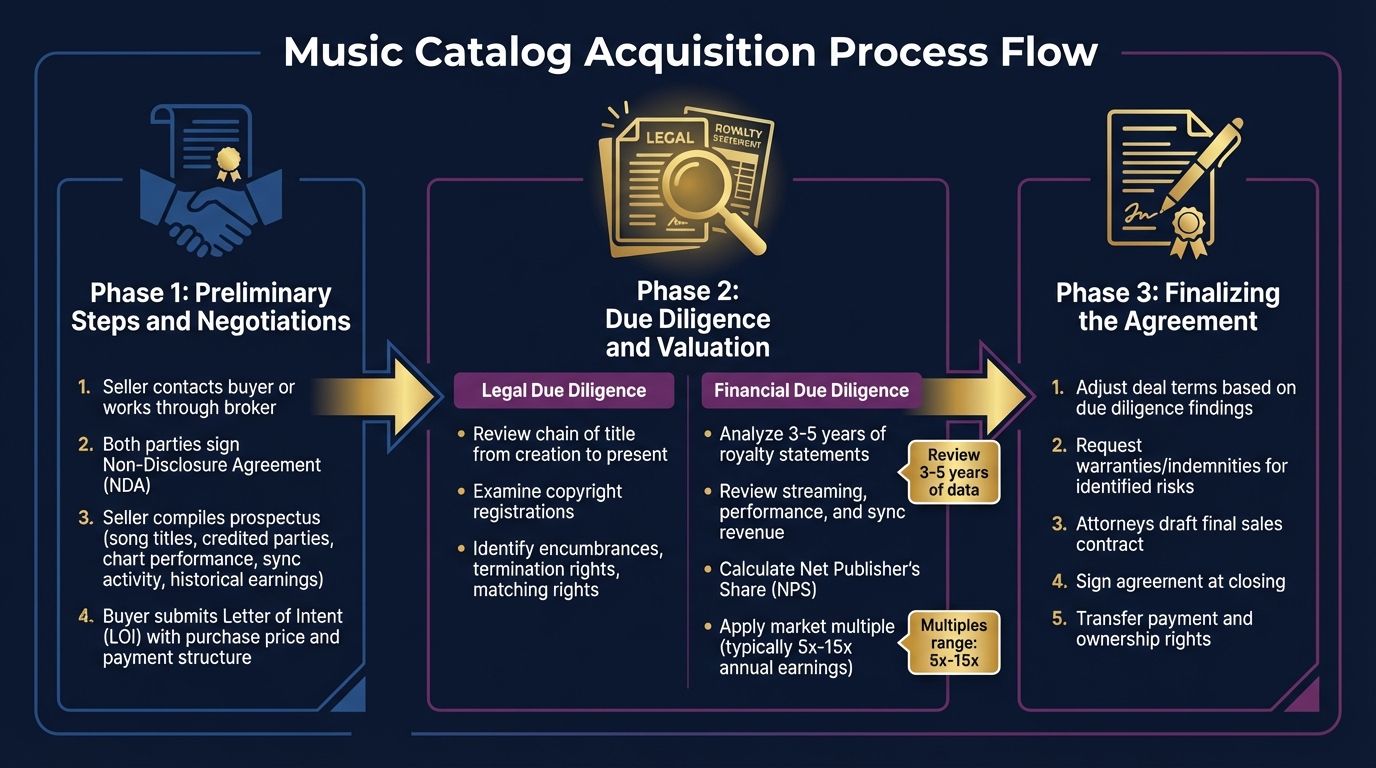
Music Catalog Acquisition Process: 3 Phases from NDA to Closing
Preliminary Steps and Negotiations
The acquisition process kicks off when a seller contacts a buyer, works through a broker, or when a buyer identifies a catalog they’re interested in purchasing[4]. Before diving into financial details, both parties sign a Non-Disclosure Agreement (NDA) to safeguard sensitive information[4].
Once the NDA is signed, the seller compiles a prospectus – a comprehensive document that includes song titles, credited parties, chart performance, synchronization activity, and historical earnings[4][6]. This document helps outline the scope of the catalog. If a buyer is interested, they submit a Letter of Intent (LOI), which lays out key preliminary terms like the purchase price and payment structure[4][6]. The LOI demonstrates mutual interest and sets the stage for further discussions.
After these initial steps, the process moves into due diligence to confirm the catalog’s value and reliability.
Due Diligence and Valuation
With legal protections in place, the buyer begins verifying the catalog’s value through detailed legal and financial assessments. Legal due diligence focuses on reviewing the chain of title – tracking ownership from the song’s creation to the present – to ensure the seller has clear rights to sell[2][4][6]. This step also includes examining copyright registrations and contracts to identify any potential issues, such as encumbrances, termination rights, or matching rights that might impact the transaction[2][4][6].
On the financial side, buyers analyze royalty statements from sources like streaming, performance, and synchronization to verify past earnings and predict future revenue[2][4]. Typically, they review three to five years of royalty data to spot trends and ensure consistency. To determine the catalog’s value, buyers often use the Net Publisher’s Share (NPS), multiplying it by a market-driven multiple, which usually falls between 5 and 15 times the annual net earnings[4].
Finalizing the Agreement
Once due diligence is complete, the deal terms are adjusted and finalized. If the buyer uncovers any risks, they may revise their offer and request warranties or indemnities to address these concerns[4][7]. Attorneys draft the final sales contract, which includes all agreed terms, the payment structure, and necessary legal protections[2][4].
At closing, the agreement is signed, the purchase price is paid, and ownership rights are officially transferred[4].
How Music Catalogs Are Valued
Once due diligence is complete, the next step is understanding how music catalogs are valued. Two primary methods dominate this process: the Earnings Multiples Method and the Net Present Value (NPV) Method. Each offers a unique way to assess a catalog’s financial worth.
Earnings Multiples Method
The Earnings Multiples Method is the go-to valuation approach in the music industry. It calculates a catalog’s value by multiplying the Net Publisher’s Share (NPS) – which is gross royalty income minus payments to writers and administrative fees – by a market-driven multiple [10] [11]. These multiples typically range from 6x to 15x annual earnings, but iconic catalogs can fetch 20x to 25x or even more [10]. Factors like market conditions, investor interest, and interest rates play a big role in determining the multiple.
Several elements influence the multiple assigned to a catalog:
- Catalogs with steady or growing income over three to five years tend to earn higher multiples (12x–15x), while those with declining revenue are valued lower (6x–8x) [10].
- Catalogs with diverse income streams – like streaming, sync licensing, and international royalties – can see multiples 20%–30% higher than those reliant on a single source [10].
- "Evergreen" catalogs, featuring timeless classics with proven longevity (10–15 years), command higher multiples because of their consistent appeal [10] [11].
- Genres such as rock, country, and jazz often hold their value better than trend-driven genres, further boosting their valuation [10].
"A catalog earning from all these sources is far less risky than one dependent on a single platform or territory." – Creative Funding Agency [10]
For example, in 2024/2025, Lana Del Rey’s album Honeymoon (1.8 billion Spotify streams) sold for $77,000 at a 9.9x multiple. On the other hand, Tate McRae’s hit "You Broke Me First" (2 billion streams) fetched $1,250,000 at a 6.92x multiple [12] [13].
| Catalog Type | Typical Multiple | Key Characteristics |
|---|---|---|
| Legendary/Nostalgic | 20x – 25x+ | Iconic artists, timeless classics, multi-generational appeal [10] |
| Premium/Stable | 12x – 15x | Consistent growth, diversified revenue, strong streaming [10] |
| Established/Moderate | 8x – 12x | Stable income, moderate or flat performance [10] |
| Emerging/Risky | 6x – 8x | Limited track record, declining revenue, niche appeal [10] |
While this method focuses on past performance, the NPV Method looks ahead to future earnings potential.
Net Present Value (NPV) Method
The NPV Method, also known as the Income Approach, estimates the present value of a catalog by discounting projected future royalties [4] [11]. This method uses a risk-adjusted discount rate to calculate the value of future cash flows in today’s terms.
To carry out an NPV analysis, evaluators examine five to seven years of historical royalty data to identify trends that help project future income [11]. They then apply a discount rate that accounts for specific risks tied to the catalog, as well as current interest rates [4] [11]. A Regression Model is often used to factor in the natural decline in a song’s popularity, which usually peaks within the first one to two years before leveling out [11].
"NPV methods involve determining the present value of a catalog’s future cash flows. In music, many acquisitions base the purchase price on the average annual net earnings… over a period of time." – Silvino E. Díaz, Esq., Director of the Entertainment Law Group, EPGD Business Law [4]
This method is particularly useful for newer catalogs, where buyers need to estimate the life cycle and risk of assets that lack a long history [11]. On the other hand, the Earnings Multiples Method is often favored for established, evergreen catalogs with proven track records [11].
Legal Protections and Best Practices
After determining the value of a music catalog, it’s essential to establish legal safeguards to ensure a smooth transaction. Without verifying ownership, reviewing contracts, or using the right legal tools, a deal can quickly fall apart. These steps build on valuation efforts to protect both parties and maintain the deal’s integrity.
Verifying Clear Ownership Rights
Before moving forward, buyers must confirm that the seller has undisputed ownership of the catalog. This involves checking records with the U.S. Copyright Office to validate registration details, reviewing past ownership transfers, and tracing the chain of title from the song’s creation to its current owner. For works created after 1978, copyright protection extends for the author’s lifetime plus 70 years, while works from before 1978 are protected for 95 years in total [2][8].
It’s also critical to conduct judgment and lien searches to identify any claims from former managers, ex-spouses, or heirs [8]. Buyers should evaluate termination rights, which allow songwriters to reclaim ownership after 35 years from publication or 40 years from the original grant [8]. Additionally, cross-referencing royalty statements with registration data ensures proper payment flows [14].
As Erin M. Jacobson, Esq., known as The Music Industry Lawyer, explains:
"Clean registrations are a major factor for writers or catalogue owners wanting to maximize collections on the works they own, because if any registration data is incorrect, the payments will not flow through to the writer or owner because it will either be held by a society, lost in a black box, or simply unpaid." [14]
Reviewing Existing Agreements
Ownership is just one piece of the puzzle. Buyers also need to carefully examine contracts tied to the catalog. Publishing deals, licensing agreements, and distribution contracts can all contain clauses that impact the catalog’s value and usability. For example, some contracts may include restrictions on usage, territorial limitations, or specific payment obligations to artists and writers.
Certain agreements might also have “matching rights” or “right of first negotiation” clauses, which require the seller to offer the deal to a prior publisher before considering third-party offers. Others may include “retention rights,” limiting the sale to passive income rather than full administrative control.
Derek Crownover, Vice Chair of the Music Industry Group at Loeb & Loeb LLP, highlights:
"The most critical legal consideration is clearly defining the precise scope of rights being sold." [7]
Using Professional Legal Tools
To reduce risks and streamline the process, professional legal tools and templates are invaluable. A well-drafted catalog acquisition agreement should clearly outline all royalty types – mechanical, performance, and synchronization – and include warranties confirming the seller’s undisputed rights. For instance, OnlineMusicContracts.Com offers a 14-page Publishing Catalog Acquisition Agreement template for $29.99, covering standard clauses to protect both parties. Purchases over $50 even include a free 30-minute consultation with an entertainment attorney [1].
Additionally, buyers should file UCC-1 financing statements to secure a legal claim over catalog proceeds. This step provides protection if the seller defaults or declares bankruptcy [5]. At closing, letters of direction should be issued to PROs and labels, ensuring royalties are redirected to the new owner [5].
Erin M. Jacobson, Esq., underscores the importance of thorough preparation:
"Buyers also need to understand that the money spent upfront in the due diligence phase is money well spent because the costs to correct a breach later will surely exceed what would have been spent on due diligence." [14]
Sellers can also increase their catalog’s appeal by cleaning up registration data before listing. Accurate records not only prevent issues like frozen royalties but can also lead to higher purchase offers [14].
Conclusion
Key Takeaways
When it comes to catalog acquisition agreements, clarity, precision, and careful research are non-negotiable for both buyers and sellers. Defining the scope of rights being transferred – whether it’s composition rights, master recordings, or both – has a direct impact on revenue streams like performance, mechanical, and sync royalties [3][4]. Buyers should confirm ownership through copyright records and judgment searches, while sellers need to review existing agreements for potential complications, such as "right of first negotiation" clauses [3].
Valuing a catalog accurately is just as critical. Approaches like the Net Present Value (NPV) method or earnings multiples (typically ranging from 5× to 15× the Net Publisher’s Share) help ensure the purchase price reflects steady, long-term earnings rather than temporary spikes [4][6]. When structured and protected correctly, music catalogs can serve as reliable and enduring assets.
Proper administration is another cornerstone. Erin M. Jacobson, Esq., highlights the risks of neglecting this aspect:
"Lack of administration creates the problem of improper collection, so [an investor] will not get the anticipated return on the investment" [6].
Ensuring royalties are redirected appropriately and registrations are up to date is essential to maintaining a catalog’s performance and profitability.
Next Steps for Artists and Buyers
To build on these insights, consider taking concrete steps toward a successful acquisition. For instance, OnlineMusicContracts.Com offers a Publishing Catalog Acquisition Agreement template for $29.99, covering essential clauses to safeguard rights and revenues [1]. Additionally, purchases over $50 come with a complimentary 30-minute consultation with an entertainment attorney, providing personalized guidance.
FAQs
What rights am I actually selling in a catalog deal?
In a catalog deal, you’re essentially selling rights to musical compositions. This can cover elements like the melody, lyrics, and arrangement of the songs. In some cases, the deal might also include rights to the master recordings, which are the actual recorded versions of the tracks. The specific rights involved depend entirely on the terms set in the catalog acquisition agreement.
How do buyers check if I really own the catalog?
Buyers verify catalog ownership through a process called legal due diligence. This involves carefully examining rights and ownership records to ensure there are no disputes or conflicting claims tied to the catalog. Having the right documentation in place is essential to confirm ownership and prevent potential problems down the line.
Can copyright termination rights affect the sale price?
Copyright termination rights can play a big role in shaping the sale price of a music catalog. These rights give authors – or their heirs – the ability to reclaim ownership of their work after a specific period. For buyers, this creates a level of uncertainty about the long-term value of the catalog.
Because of this potential for rights to revert back to the original creators, buyers often factor in the risk when evaluating how much the catalog is worth. This can lead to a lower perceived value, as the ownership and revenue streams might not be guaranteed over time.